KH
KH  FR
FR  AR
AR CN
CNThailand Uses UNCLOS Move as Pretext to Suspend JBC Talks, Says Cambodian Senate First Vice President
AKP Phnom Penh, July 08, 2026 -- Cambodia has told the Executive Committee Meeting of the Assemblée Parlementaire de la Francophonie (APF) that Thailand used Cambodia's recourse to dispute settlement procedures under the UN Convention on the Law of the Sea (UNCLOS) as a pretext to suspend meetings of the Cambodia-Thailand Joint Boundary Commission (JBC).
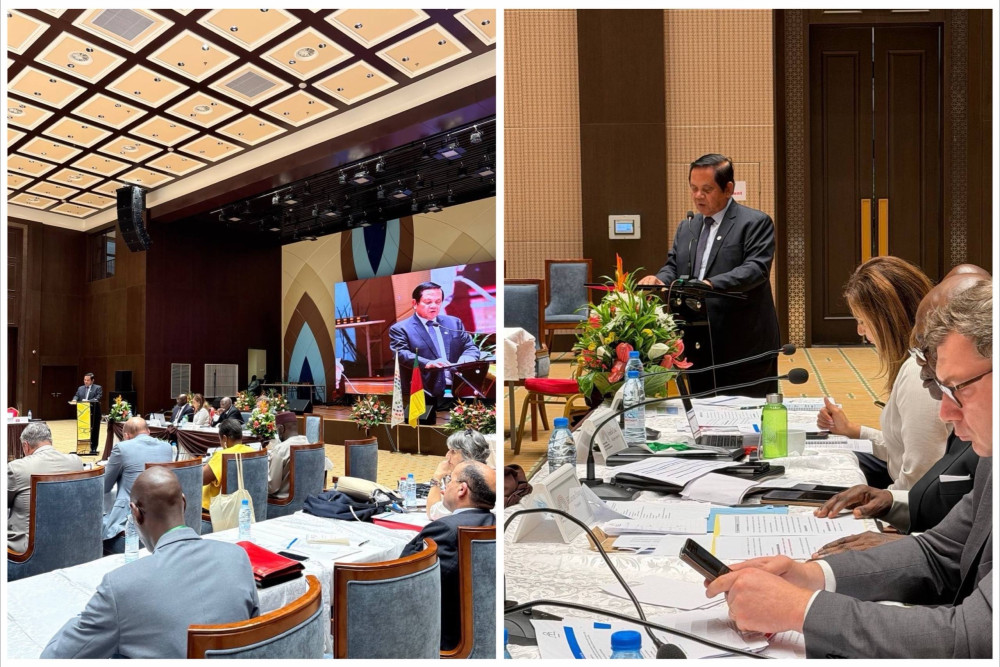
Addressing the meeting in Yaoundé, Cameroon, on July 7, H.E. Ouch Borith, First Vice President of the Cambodian Senate, Head of Cambodia's APF Section, and APF Vice President, said Cambodia had exercised its right under UNCLOS to seek compulsory conciliation procedures in line with its international obligations and to ensure a peaceful and lawful settlement of disputes.
However, he said Thailand had cited Cambodia's UNCLOS initiative as justification for suspending JBC meetings, despite the commission being a purely technical bilateral mechanism that should not be linked to political considerations.
H.E. Ouch Borith added that, despite Cambodia's repeated requests to convene the commission, its work has not resumed, undermining bilateral cooperation and mutual trust while encouraging the creation of a fait accompli, which he said runs counter to the principles of peaceful dispute settlement and respect for international law.
He also said Thailand's unilateral withdrawal from the 2001 Memorandum of Understanding on overlapping maritime claims had dismantled a bilateral framework that had enabled constructive dialogue on the sensitive issue for more than 25 years.
The Senate First Vice President reaffirmed that Cambodia remains committed to resolving disputes through the rule of law, dialogue, and multilateral mechanisms, reflecting its belief that respect for international law offers the strongest guarantee for lasting peace and good-neighbourly relations.
He expressed confidence that the continued support of the international community and the Francophone parliamentary family for the principles of sovereignty, territorial integrity, non-use of force, good-faith implementation of agreements, and peaceful settlement of disputes would help safeguard regional stability, mutual trust among states, and the credibility of the international legal order.
By C. Nika