KH
KH  FR
FR  AR
AR CN
CNSenate President Highlights the International Law as Foundation for Resolving Cambodia–Thailand Border Issue
AKP Phnom Penh, July 09, 2026 -- Senate President Samdech Akka Moha Sena Padei Techo Hun Sen has underscored that respect for international law, existing treaties and the rulings of the International Court of Justice (ICJ) remains the only sustainable path toward resolving the long-standing Cambodia–Thailand border issue.
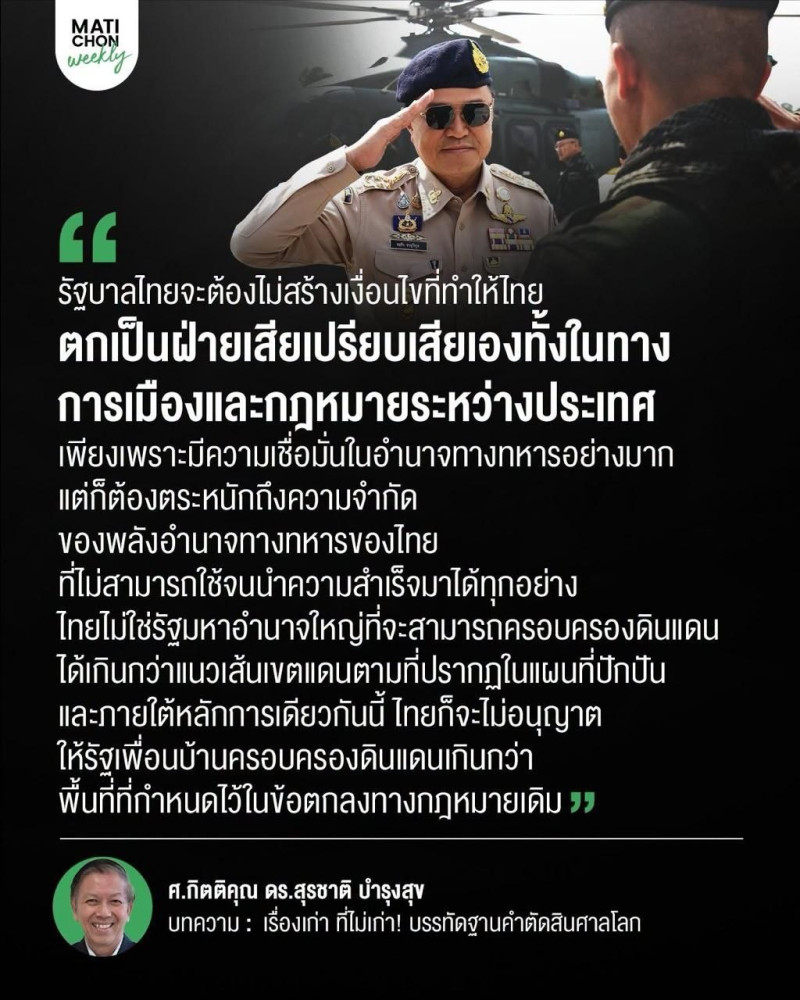
In a message shared on Thursday, Samdech Techo Hun Sen introduced an unofficial Khmer translation of an article written by Thai international relations and security scholar Surachart Bamrungsuk, titled "An Old Story That Is Still Relevant: The Judgment Established by the International Court of Justice."
The article revisits the significance of the ICJ's 1962 ruling on the Preah Vihear Temple dispute in light of current border tensions between Cambodia and Thailand.
Samdech Techo Hun Sen stressed that he was merely sharing the translated article for the benefit of the Cambodian and Thai public, without adding his own commentary, while encouraging people in both countries to carefully consider its contents.
The article argues that one of the fundamental purposes of border delimitation is to ensure certainty, stability and lasting peace between neighbouring states. It cites the ICJ's 1962 judgment, which stated that established borders should not be subject to endless challenges or revisions whenever one party later identifies alleged flaws in earlier agreements.
According to the article, reopening settled border arrangements would create perpetual uncertainty, increase the risk of territorial disputes and potentially lead to armed conflict. Instead, it emphasises that treaties, officially recognised maps and legal agreements ratified by both sides must serve as the primary basis for resolving any disagreements.
The article also warns against relying on military force to settle border disputes, noting that international law does not recognise territorial changes achieved through force. Even where temporary military control may occur, any final settlement must ultimately return to internationally recognised legal principles and agreed boundary arrangements.
Another key point highlighted is that technical issues arising from geographical changes or unclear sections of the border should be addressed through bilateral mechanisms, particularly the Cambodia–Thailand Joint Boundary Commission (JBC), rather than through confrontation.
The Thai scholar further cautions that Thailand should avoid creating circumstances that could lead to a third ICJ case over the Cambodia–Thailand border, recalling that both the 1962 judgment and the ICJ's 2013 interpretation of the Preah Vihear ruling have already established important legal precedents accepted by Thailand.
By sharing the article, Samdech Techo Hun Sen sought to reaffirm that peaceful dialogue, adherence to international law and respect for previously agreed legal instruments remain essential for safeguarding regional stability and preventing border disputes from escalating into wider conflict.
By Heng Panha