KH
KH  FR
FR  AR
AR CN
CNOp-Ed: Japan’s New Regional Initiatives and Cambodia’s Development Opportunities
AKP Phnom Penh, May 16, 2026 --
Japan’s latest foreign and economic policy initiatives reflect an important evolution in the Indo-Pacific’s economic and strategic landscape. Through the updated Free and Open Indo-Pacific (FOIP) strategy, the Asia Zero-Emission Community (AZEC), expanded economic-security cooperation, and enhanced regional partnerships, Japan is placing greater emphasis on technology, supply-chain resilience, energy security, and sustainable development.
For Cambodia, these developments should not be viewed through the lens of geopolitical rivalry or strategic competition among major powers. Rather, they should be understood as emerging opportunities that can support Cambodia’s long-term national development agenda and its ambition to become a high-income country by 2050.
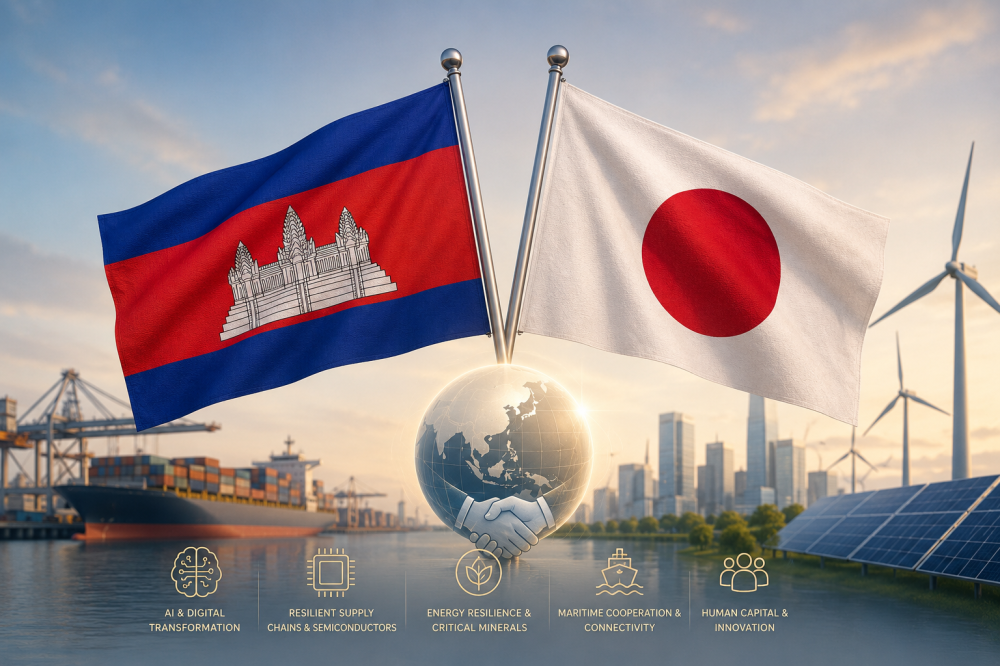
A closer look at Japan’s recent policies reveals several interconnected priority areas. At the centre is the development of AI- and data-based economic infrastructure and broader technological transformation. This is followed by resilient supply chains and semiconductor cooperation, energy resilience and critical minerals, and maritime cooperation for regional stability and connectivity. Together, these priorities align closely with Cambodia’s need to modernize its economy, strengthen resilience, and enhance competitiveness in an increasingly technology-driven world.
The most significant aspect of Japan’s evolving strategy is its strong emphasis on science, technology, and AI-driven economic infrastructure. Around the world, digital transformation is reshaping economies, industries, and governance systems. Artificial intelligence, big data, cloud computing, smart logistics, digital finance, and cybersecurity are becoming essential foundations for future growth and productivity.
For Cambodia, this transition is particularly important. The country has achieved remarkable economic progress over the past decades, but sustaining long-term growth will require moving beyond traditional development models that rely heavily on low-cost labour and labour-intensive manufacturing. Cambodia must gradually build a more innovation-driven and knowledge-based economy capable of competing in the digital era.
In this regard, Japan’s focus on trusted technology, digital infrastructure, and human resource development presents valuable opportunities for Cambodia. Cooperation in areas such as digital governance, AI training, smart cities, fintech, e-commerce, and cybersecurity could help strengthen Cambodia’s institutional capacity and economic competitiveness. Japanese expertise in high-quality infrastructure and technology management may also contribute to Cambodia’s efforts to modernize public administration and improve service delivery.
Equally important is the development of human capital. Cambodia’s digital transformation will depend not only on infrastructure but also on the ability of its workforce to adapt to rapidly changing technological demands. Strengthening education, technical training, research capacity, and digital literacy should therefore become national priorities. Partnerships with Japan in education, science, technology, and innovation can help support this transition.
Another major priority in Japan’s policies is resilient supply chains and semiconductor cooperation. Recent global disruptions have highlighted the importance of diversified and reliable production networks, particularly in strategic sectors such as electronics, semiconductors, and advanced manufacturing.
This trend may create new opportunities for Cambodia to deepen its participation in regional and global value chains. Although Cambodia is not yet positioned to become a semiconductor producer, it can gradually integrate into supporting industries through electronics assembly, logistics services, industrial parks, and technical manufacturing.
Cambodia’s strategic location within ASEAN and improving connectivity infrastructure could strengthen its attractiveness as a complementary production and logistics hub.
To fully benefit from these opportunities, Cambodia will need continued investment in infrastructure, energy reliability, technical education, regulatory efficiency, and the overall business environment. Long-term competitiveness will depend not only on attracting investment but also on improving productivity and technological capabilities.
Energy resilience and critical minerals represent another important dimension of Japan’s evolving regional engagement, particularly under the AZEC framework. As countries pursue energy transition and sustainable development, access to stable energy supplies, renewable technologies, and strategic resources is becoming increasingly important.
Japan’s approach is notable because it seeks to balance environmental sustainability with economic growth and energy security. This pragmatic perspective is highly relevant for developing countries like Cambodia, which continue to face growing energy demand while also addressing climate and sustainability challenges.
Cooperation with Japan in renewable energy, energy efficiency, smart grids, and sustainable infrastructure could support Cambodia’s long-term development objectives. In addition, participation in regional green industrial cooperation and emerging supply chains related to clean technologies may open new economic opportunities for Cambodian industries and businesses.
Maritime cooperation is another area where Cambodia can benefit constructively. As a trading nation increasingly connected to regional and global markets, Cambodia depends on stable sea lanes, efficient logistics, and secure regional connectivity. A strong example is the continued development of the Sihanoukville Autonomous Port, Cambodia’s only deep-sea international port. Over the years, Japan, particularly through JICA, has supported the port’s modernization through concessional loans, technical assistance, and container terminal expansion projects. This cooperation has helped strengthen Cambodia’s trade connectivity and logistics capacity while supporting the country’s broader economic modernization goals.
Importantly, Cambodia’s engagement with Japan’s initiatives should be understood within the framework of Cambodia’s long-standing independent and balanced foreign policy. Cambodia consistently pursues cooperation with all partners based on mutual respect, mutual benefit, non-interference, and shared development interests. Strengthening cooperation with Japan does not come at the expense of relations with any other country.
Cambodia’s foreign policy has consistently emphasized friendship with all countries and peaceful coexistence with all nations. As a small state in an increasingly complex international environment, Cambodia continues to uphold the principles of the United Nations Charter, international law, multilateralism, mutual respect for sovereignty, and a rules-based international order. Cambodia also supports an open, inclusive, and pluralistic liberal trade system that promotes shared prosperity and interdependence rather than division and confrontation. Within this framework, Cambodia seeks to engage constructively with all partners while preserving its strategic autonomy, national interests, and commitment to regional peace and stability.
Indeed, Cambodia’s development success has long depended on maintaining constructive relations with a wide range of partners, including ASEAN member states, China, Japan, South Korea, the United States, the European Union, and many others. This diversified approach remains essential in an increasingly interconnected and uncertain global environment.
Ultimately, Cambodia’s journey toward becoming a high-income country by 2050 will require more than sustained economic growth. It will require technological upgrading, stronger institutions, improved human capital, resilient infrastructure, and the ability to adapt to major global transformations.
Japan’s emerging priorities in technology, supply chains, energy resilience, and sustainable connectivity offer Cambodia valuable opportunities to support these national objectives. By engaging constructively and pragmatically with such initiatives, while maintaining balanced relations with all partners, Cambodia can strengthen its capacity to achieve long-term prosperity, resilience, and inclusive development.
By Dr. Kin Phea
Alternative Member of Royal Academy of Cambodia (RAC) & Director General of the International Relations Institute of Cambodia (IRIC), RAC