KH
KH  FR
FR  AR
AR CN
CNOPINION: Thailand Is Afraid of the Facts
AKP Phnom Penh, December 26, 2025 -- Thailand admits it bombed deep inside Cambodia. Cambodia asked for independent checks. Thailand refused all of them.
If your actions are legal, you don’t block scrutiny.
Refusing verification isn’t neutrality. It’s fear.
The facts exist.
The photos exist.
History doesn’t need Thailand’s permission to judge.
THAILAND IS AFRAID OF THE FACTS
There is a moment in every conflict when the question changes.
At first, people argue about who fired first.
Then they argue about maps, history, and grievances.
Eventually, only one question matters:
Who is willing to let the world see what happened.
On December 13, a bridge in Pursat province was destroyed by an airstrike.
Thailand acknowledged the strike.
The bridge lay sixty kilometers inside Cambodian territory. It connected villages to markets, schools, and clinics. Farmers crossed it routinely. Children used it to reach school.
That fact is not disputed.
What remains disputed is what else was hit that day, and in the days around it.
One central reason explains that dispute: Thailand has refused independent verification.
THIS IS NO LONGER ABOUT WHO STARTED IT
Cambodia has fired rockets.
Cambodia has laid mines.
Cambodian actions have killed and injured Thai soldiers and civilians, as reported by Thai authorities and international media.
These facts matter.
They must be investigated.
But acknowledging them does not end the analysis.
It begins it.
Self-defence under international law is not a slogan.
It is a test.
Force must be necessary.
Force must be proportionate.
And force must be demonstrable.
Demonstrable means evidence.
Scrutiny requires independent access.
Thailand has refused that repeatedly.
WHAT THAILAND ADMITS, AND WHAT IT WITHHOLDS
Thailand has admitted to airstrikes, artillery fire, and naval operations on Cambodian territory.
It has confirmed the use of F-16 aircraft.
It has confirmed strikes far beyond the immediate border zone.
What Thailand has not done is allow anyone to examine whether those strikes met the legal tests it claims justify them.
In one recent case involving airstrikes on alleged scam compounds, Thai commanders confirmed the attacks but declined to provide evidence that the targets were military in nature, citing classification.
The strike was acknowledged.
The justification was withheld.
That pattern repeats.
Cambodia has requested independent observers. Thailand has refused.
Cambodia has requested satellite or forensic review. Thailand has rejected it.
Cambodia has sought ICJ adjudication. Thailand has declined jurisdiction.
Cambodia has requested monitored ceasefires. Thailand has conditioned or delayed them.
This is not a failure of diplomacy.
It is a pattern of refusal.
REFUSAL IS NOT NEUTRAL
At this point, the international community is left with two explanations:
Either Thailand knows that independent verification would not support its claims of necessity and proportionality.
Or Thailand believes its power makes verification unnecessary.
Legal vulnerability.
Or contempt for law.
If there is a third explanation, Thailand has not offered it.
This is not an accusation of intent.
It is an inference drawn from conduct.
Thailand could end it tomorrow by accepting scrutiny.
It has chosen not to.
THE HUMAN COST IS NOT ABSTRACT
United Nations agencies have documented civilian displacement in the hundreds of thousands linked to this conflict. Schools have closed. Clinics have been damaged. Entire communities have been uprooted.
This is what proportionality is meant to prevent.
A bridge is not a combatant.
A school is not a military objective.
A market road is not a threat.
If these were legitimate targets, verification would prove it.
If precautions were taken, scrutiny would show it.
If civilian harm was unavoidable, examination would document why.
Refusal does none of this.
SILENCE IS NOT CONFIDENCE
Since publishing my first piece, I have received messages from Thai academics, journalists, former officials, and business leaders.
They do not all agree with me.
But many agree on one thing: this cannot be discussed openly.
I am not here to speak for them.
I am here to state a fact.
A nation confident in its conduct does not fear examination.
A nation that insists it must not be examined reveals something else.
Thailand is not weak.
Thailand is afraid.
AFRAID OF WHAT?
Ground photographs of the destroyed Chey Chumneas Bridge in Pursat already exist and have been widely published by Cambodian authorities and international media. The damage is visible. It will not disappear.
Somewhere there is a list of names.
The people who lived near that bridge.
The children who crossed it to reach school.
Someone is writing those names down.
It will depend on records.
And records do not require permission.
Thailand still has a choice.
It can allow independent verification.
It can submit evidence.
It can let the facts speak.
Until it does, the refusal itself is the evidence.
Afraid of what?
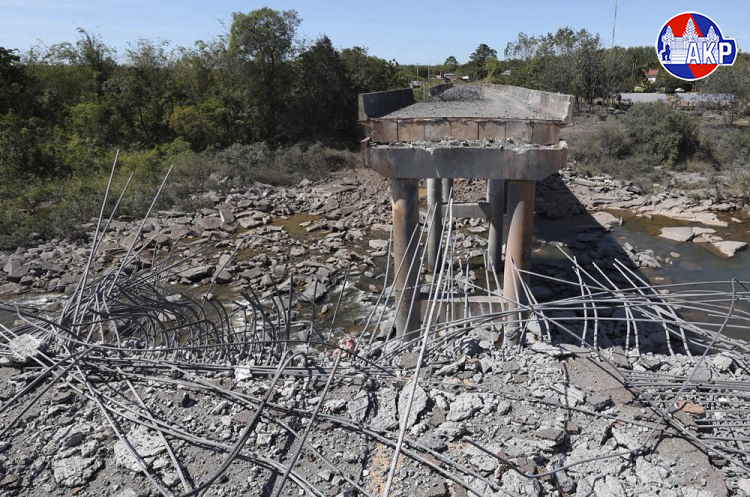
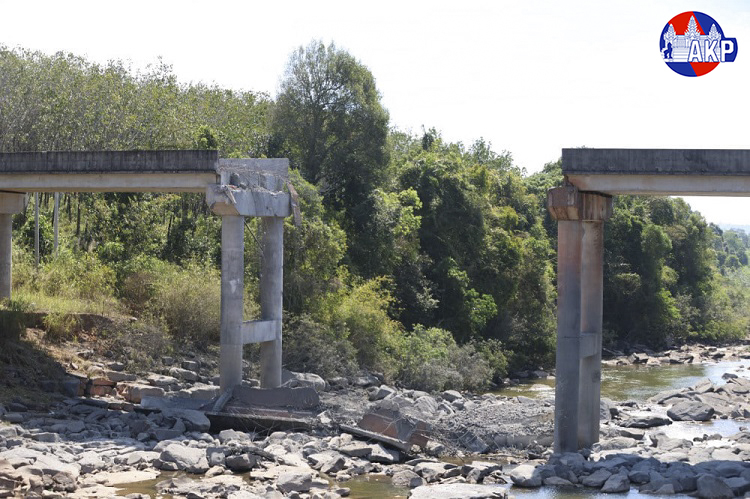
Chey Chumneas Bridge in Thmar Da commune, Veal Veng district, Pursat province, is destroyed by Thai F-16 fighter jets on Dec. 13, 2025.
By Arnaud Darc
Chairman & CEO, Thalias Hospitality Group
(The views expressed are his own)