KH
KH  FR
FR  AR
AR CN
CNCambodian Senate Rejects Thai Claims, Says Ceasefire Cannot Alter Sovereignty or Borders
AKP Phnom Penh, August 31, 2026 --
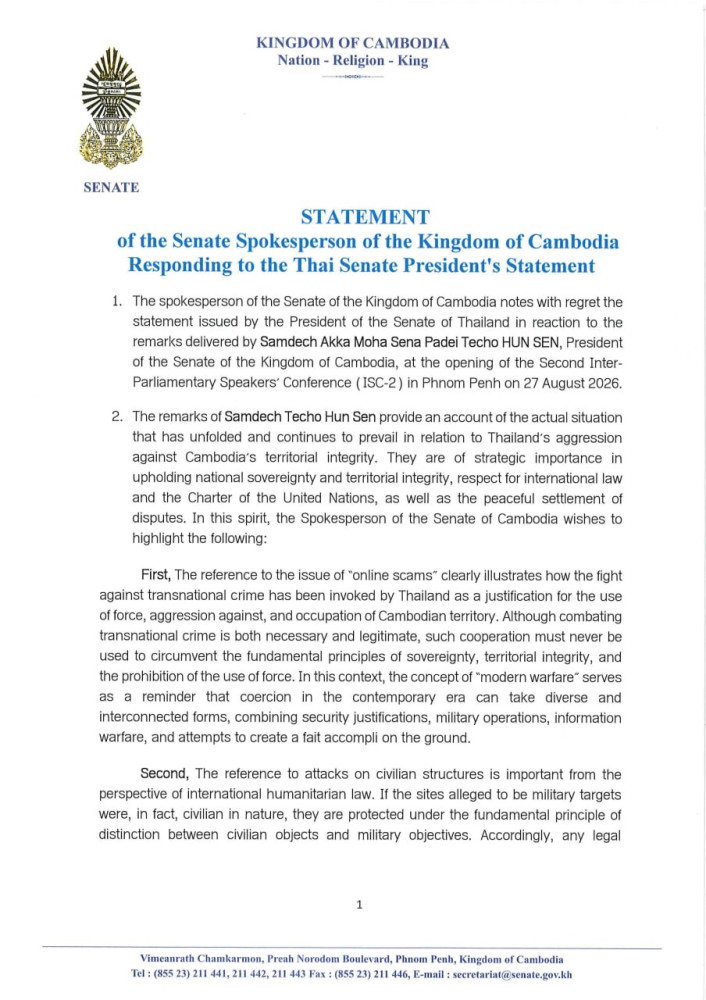
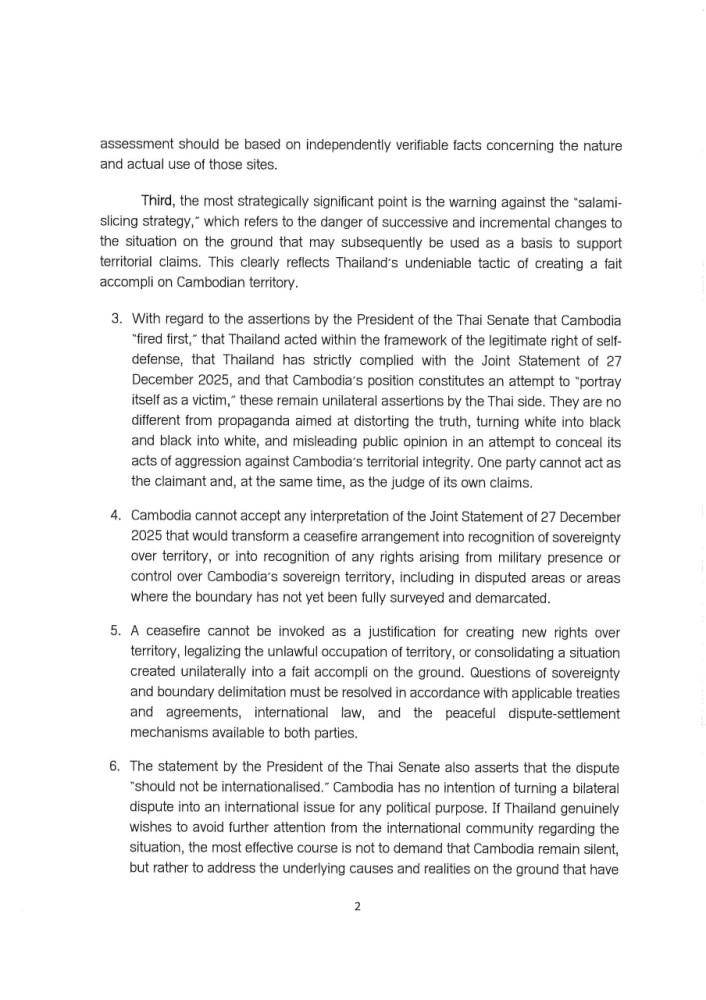
The Spokesperson of the Senate of the Kingdom of Cambodia has rejected recent statements by the President of the Thai Senate regarding the Cambodia-Thailand border dispute, reaffirming Cambodia’s position that territorial issues must be addressed in accordance with international law and through peaceful mechanisms.
In a statement responding to the Thai Senate President’s remarks concerning those made by Samdech Akka Moha Sena Padei Techo Hun Sen, President of the Cambodian Senate, at the opening of the Second Inter-Parliamentary Speakers’ Conference (ISC-2) in Phnom Penh on Aug. 27, the Cambodian Senate spokesperson expressed regret over the Thai position.
The spokesperson said Samdech Techo Hun Sen’s remarks reflected the situation surrounding Thailand’s aggression against its territorial integrity and underscored the importance of upholding national sovereignty, territorial integrity, international law, the UN Charter and the peaceful settlement of disputes.
The Cambodian Senate also rejected the use of cross-border online scam operations as a justification for the use of force or military action. While combating transnational crime is necessary and legitimate, such cooperation cannot override the fundamental principles of sovereignty, territorial integrity and the prohibition of the use of force, it said.
The statement, released this morning, further noted that attacks on civilian structures must be assessed in accordance with international humanitarian law, particularly the principle of distinction between civilian objects and military objectives. Any legal assessment, it added, should be based on independently verifiable facts concerning the nature and actual use of the sites concerned.
The Cambodian Senate spokesperson also warned against what was described as a “salami-slicing strategy,” referring to the gradual alteration of the situation on the ground that could later be used to support territorial claims. Such actions, the statement said, risk creating a “fait accompli” in Cambodian territory.
Regarding the Thai Senate President’s claims that Cambodia had fired first, that Thailand had acted in legitimate self-defence, and that Thailand had strictly complied with the Joint Statement of Dec. 27, 2025, the Cambodian side described these as unilateral claims.
The spokesperson said one party to a dispute could not simultaneously act as the claimant and judge its own claims, while accusing the Thai side of attempting to distort facts and conceal acts of aggression against Cambodian territorial integrity.
The Cambodian Senate stressed that the Dec. 27, 2025 Joint Statement must not be interpreted as recognising sovereignty or any rights arising from military presence or control over Cambodian territory, disputed areas or areas whose boundaries have not yet been clearly demarcated.
“A ceasefire cannot be used as a basis for creating new territorial rights, legitimising illegal occupation, or consolidating a unilateral fait accompli,” the statement said, emphasising that sovereignty and boundary issues must be resolved in accordance with applicable treaties and agreements, international law and peaceful dispute-settlement mechanisms available to both sides.
The statement also addressed the Thai Senate President’s assertion that the dispute should not be internationalised.
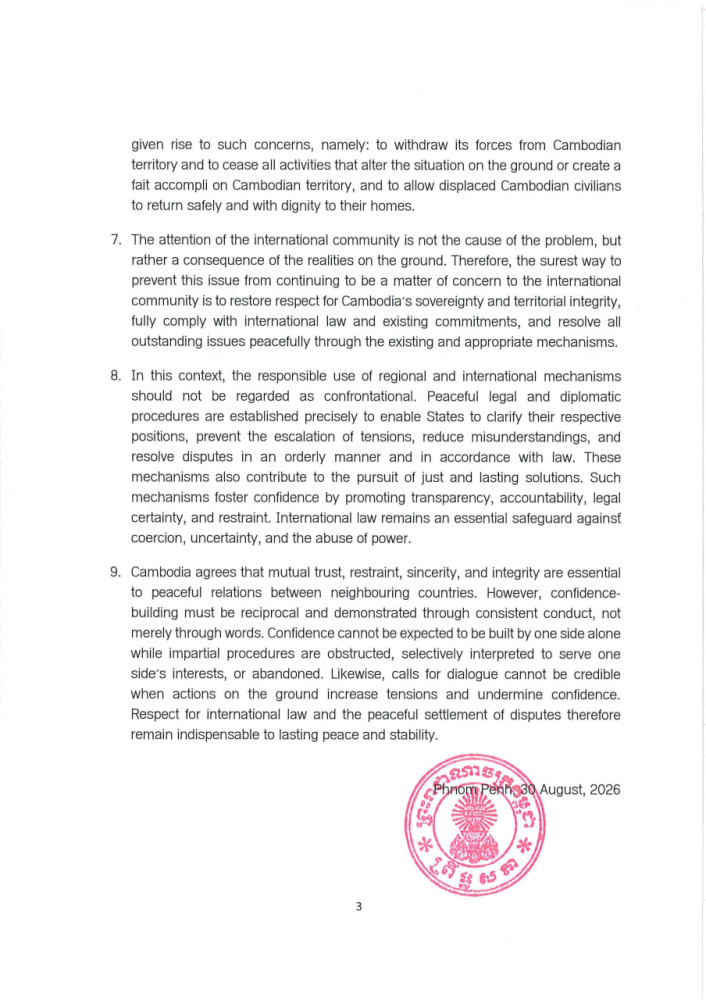
Cambodia, it said, has no intention of turning a bilateral dispute into an international issue for political purposes. If Thailand genuinely wishes to avoid greater international attention, the most effective approach would be to address the underlying situation by withdrawing its forces from Cambodian territory, stopping actions that alter the situation on the ground, and allowing displaced Cambodian civilians to return safely and with dignity to their homes.
The Cambodian Senate stressed that international attention is not the cause of the problem but rather a consequence of the situation on the ground.
It called for respect for Cambodia’s sovereignty and territorial integrity, full implementation of international law and existing commitments, and the peaceful resolution of outstanding issues through appropriate mechanisms.
The statement further emphasised that the responsible use of regional and international mechanisms should not be viewed as confrontation. Legal and diplomatic mechanisms are intended to clarify the positions of states, prevent escalation, reduce misunderstandings and facilitate orderly and lawful dispute settlement, it said.
Such mechanisms can also contribute to fair and lasting solutions by promoting transparency, accountability, legal certainty and restraint, while international law remains an important safeguard against coercion, uncertainty and the abuse of power.
The Cambodian Senate spokesperson acknowledged that mutual trust, patience, honesty and integrity are essential to peaceful relations between neighbouring countries. However, trust must be mutual and demonstrated through consistent actions rather than words alone.
“Peaceful dialogue cannot be credible while actions on the ground increase tensions and undermine trust,” the statement said, reaffirming that respect for international law and the peaceful settlement of disputes remain indispensable to achieving lasting peace and stability between Cambodia and Thailand.
By C. Nika