KH
KH  FR
FR  AR
AR CN
CNWorld Economic Forum Offers Bleak Global Outlook Ahead of Davos Meeting
AKP Phnom Penh, January 16, 2025 --
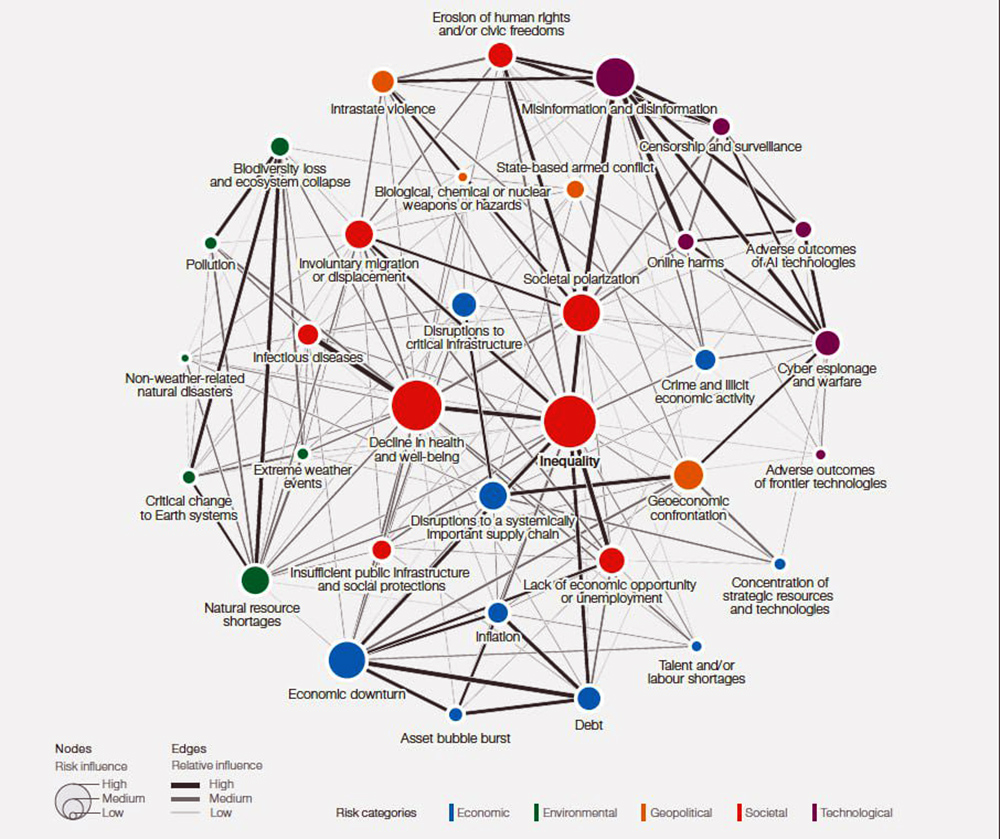
The World Economic Forum’s annual Global Risks Report finds that state-based armed conflict is the biggest risk to the world in 2025 followed by extreme weather and geo-economic confrontation.
Released on Wednesday ahead of the forum’s annual meeting in the Swiss ski resort of Davos next week, the report identifies misinformation and disinformation along with societal polarization as the other main risks.
“Today, geopolitical risk – and specifically the perception that conflicts could worsen or spread – tops the list of immediate-term concerns,” says Saadia Zahidi, a managing director at the Geneva-based group that runs the forum.
“Societal risks such as inequality rank high among today’s leading concerns as well as over the last years,” she says. “Polarisation within societies is further hardening views and affecting policy-making.
“It also continues to fan the flames of misinformation and disinformation,” Zahidi adds. “Efforts to combat this risk are coming up against a formidable opponent in Generative AI-created false or misleading content that can be produced and distributed at scale.”
GEO-ECONOMIC CONFRONTATION A ‘PROMINENT CONCERN’ IN EAST ASIA
The report notes recent research assessing the vulnerability of 173 countries to restrictive US trade measures.
South Korea was found to be the most at risk, based on American concerns over its trade deficits with other economies, restrictions on market access for US exports and existing tariffs.
China, Japan, Canada and India were at the next level of risk followed by Brazil, the EU, Indonesia, Ireland, Italy, Kenya, Malaysia, Mexico and Thailand.
The assessment is in line with the forum’s recent Executive Opinion Survey, which shows that geo-economic confrontation — like sanctions, tariffs and investment screening — is a “prominent concern in Eastern Asia, in particular.”
In Taiwan, China and Hong Kong, such economic are the third-most significant concern in their two-year outlooks.
“Moreover, 12 other economies, including Japan and South Korea, rank geo-economic confrontation among their top 10 risks,” the report says.
EMERGING AND LOW-INCOME ECONOMIES LIKELY TO SUFFER THE MOST
“While Eastern Asia may be one region most immediately impacted by new trade restrictions, broadening global geo-economic fragmentation would affect all economies, with those likely to suffer the most ultimately being emerging markets and low-income countries.”
In addition to the outlook for this year, the survey also covered global risk expectations over the coming 2 and 10 years.
In the short term, misinformation and disinformation are seen as the biggest risks in the period to 2027.
Extreme weather and armed conflict come next follow by societal polarisation, and cyber espionage and warfare.
But over the long-term period to 2037, risks related to climate change dominate.
The top four risks are extreme weather, biodiversity loss and ecosystem collapse, critical change to Earth systems, and shortages of natural resources. Misinformation and disinformation rank fifth.
Although Southeast Asian respondents to the survey have similar assessments, they fret more about the adverse outcomes of artificial intelligence ((AI) than the world average.
AI concerns are seen as the fourth-biggest long-term risk in Southeast Asia, behind critical change to Earth systems, extreme weather, and biodiversity loss and ecosystem collapse.
Southeast Asians had similar concerns as respondents worldwide about misinformation and disinformation, which was seen as the fifth-biggest risk — in line with the global ranking.
DIVISIVE MISINFORMATION AND DISINFORMATION MORE UBIQUITOUS
On the latter, the report notes “many ways in which a proliferation of false or misleading content is complicating the geopolitical environment.
“It is a leading mechanism for foreign entities to affect voter intentions; it can sow doubt among the general public worldwide about what is happening in conflict zones; or it can be used to tarnish the image of products or services from another country.”
Moreover, the report says, “it is becoming more difficult to differentiate between AI- and human-generated misinformation and disinformation.
“AI tools are enabling a proliferation in such information in the form of video, images, voice or text. Leading creators of false or misleading content include state actors in some countries.”
At the same time, “rising use of digital platforms and a growing volume of AI-generated content are making divisive misinformation and disinformation more ubiquitous.
“Algorithmic bias could become more common due to political and societal polarisation and associated misinformation and disinformation.”
GROWING INFORMATION RISKS IN BIOTECH SECTOR
In the years ahead,” the report adds, “understanding the risks in the field of biotech is going to become increasingly important at an individual level.
“Misinformation and disinformation around biotech is a serious problem, with biohackers who are not medical professionals touting health remedies or performance-enhancing procedures based on biotech.
“As these uses of biotech become more ubiquitous, individuals will need to gain a more nuanced understanding of when it can be helpful to them, and when it may pose a danger to their health.
“A collaborative educational effort between the public sector, companies in the biotech sector, and educational institutions should be launched to deepen citizens’ understanding of the technology and its risks.”
By Sao Da