KH
KH  FR
FR  AR
AR CN
CNCambodia Protests Thai Religious Activities at Ta Krabey Temple
AKP Phnom Penh, April 23, 2026 --
Cambodia’s Ministry of Cult and Religion has strongly protested the continued presence of Thai authorities and citizens conducting religious prayer activities at Ta Krabey Temple and surrounding areas, which lie within Cambodia’s sovereign territory.
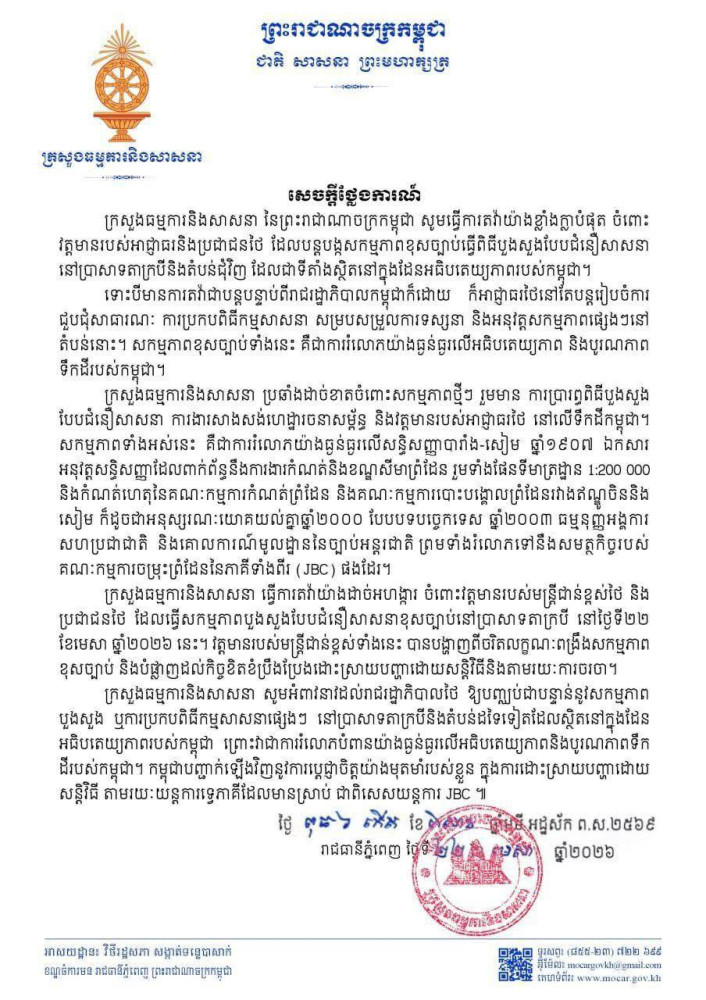
In a statement dated April 22, the Ministry said that despite repeated formal protests by the Royal Government of Cambodia, Thai authorities have continued to organise public gatherings, hold religious ceremonies, facilitate visits, and carry out related activities at the site.
The Ministry stated that such unlawful actions constitute serious violations of Cambodia’s sovereignty and territorial integrity, while also undermining ongoing efforts to address border issues through peaceful means.
Cambodia further objected to recent activities including religious ceremonies, infrastructure construction, and the presence of Thai officials on Cambodian territory. The statement said these actions contravene the Franco-Siamese Treaty of 1907, its related delimitation and demarcation instruments, including the maps at scale 1:200,000 and the Procès-Verbaux of the Commissions of Delimitation and Demarcation and the Commission for the Delimitation of the Boundary between Indo-China and Siam, as well as the MOU 2000, the TOR 2003, the Charter of the United Nations, and the fundamental principles of international law and also violate the competence of the Joint Boundary Commission (JBC) of the two parties.
The Ministry also specifically protested the presence of senior Thai officials and Thai nationals who took part in religious worship at Ta Krabey Temple on April 22, saying the move reinforced unlawful activities and hindered efforts to resolve the issue through dialogue and negotiations.
Cambodia called on the Royal Thai Government to immediately cease all prayer activities and religious ceremonies at Ta Krabey Temple and other areas under Cambodian sovereignty, while reaffirming its commitment to resolving the issue peacefully through existing bilateral mechanisms, particularly the JBC.
By C. Nika